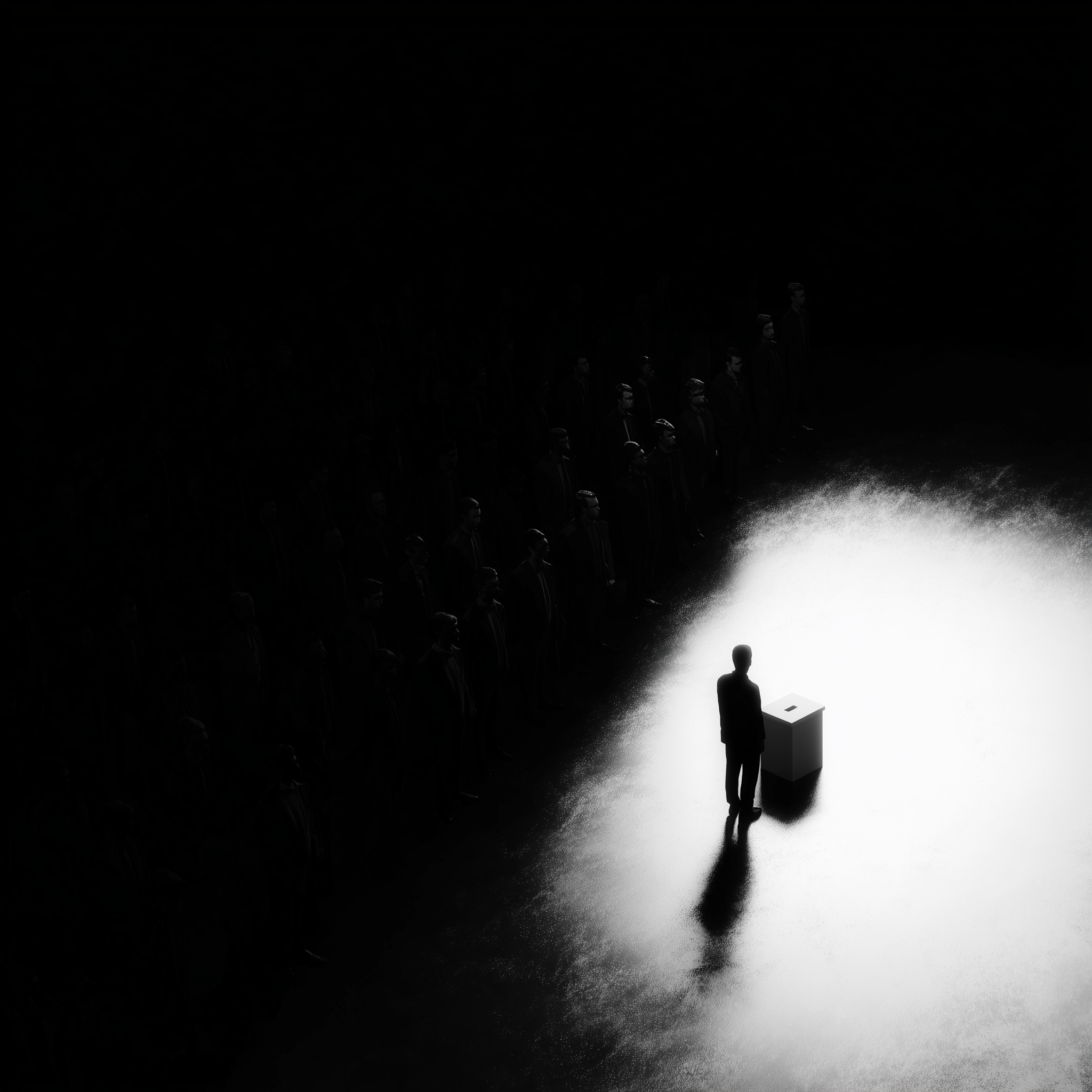
It’s hard to find a word more moralized, debated over and undefined inside the Bourgeois catalogue of Ideology as”fascism”. It is wielded as a moralistic bludgeon, an epithet for any form of authority the liberal dislikes, the absolute evil used to herd the proletariat into the arms of its “democratic” exploiters.
The “Anti-Fascist” crusade is the highest form of bourgeois mystification, a trap that has sent the proletariat to die time and time again.
The communist program has no time for this moralistic hysteria. For the materialist, fascism is not a mystery, a demonic ideology, or a relapse into barbarism. It is a category. It is a specific, modern, and historically determined form of the class rule of the bourgeoisie, which arises under definite conditions and serves a definite function.
To analyze fascism is to tear away its monstrous mask and reveal the rational class interest that lies beneath. It is to understand that the struggle is not between the "good" democracy and the "evil" fascism, but between two different methods of managing the same system of capitalist exploitation. This short note is a clarification of the Marxist position on the question.
I. The Scientific Definition of Fascism
Fascism is not an anti-capitalist movement. It is the open, terroristic dictatorship of the most reactionary, most chauvinistic, and most imperialist elements of finance capital. This is the scientific definition, first formulated by the Communist International in its revolutionary period. Let us dissect its components.
Open and Terroristic: Unlike bourgeois democracy, which veils its class dictatorship behind the fiction of elections and legal equality, fascism casts off the mask. It openly employs systematic, extra-legal terror as its primary method of rule. Its target is the organized political movement of the proletariat—the party, the unions, the workers' councils. Its function is to physically annihilate any form of vanguard of the working class.
Dictatorship of Finance Capital: Fascism does not represent the interests of the petty bourgeoisie that forms its mass base. It is, from start to finish, an instrument of the most powerful and concentrated sections of the capitalist class. It is the method of rule employed by big capital when the crisis has reached a point where the normal mechanisms of parliamentary democracy are no longer sufficient to contain the class struggle.
Fascism is, therefore, one of the forms of the modern bourgeois state. It is not a throwback to feudalism or a unique evil, but simply a product of capitalism.
II. The Social Base of the Counter-Revolution
While fascism is a tool of the big bourgeoisie, its mass army is not composed of bankers and industrialists. The social base of fascism is the petty bourgeoisie—the small shopkeepers, the artisans, the indebted farmers, the declassed intellectuals, and the permanently insecure middle classes.
This is a class caught in a state of permanent terror. It is being crushed from above by the competition of big capital and threatened from below by the rise of the organized proletariat. Lacking a scientific understanding of its own demise, it projects its own pathology onto the world. It is simultaneously anti-capitalist (in a reactionary, romantic sense, hating the banks and department stores) and violently anti-proletarian (hating the unions, the strikes, and the threat to its small property).
Fascism seizes upon this desperate, hysterical mass. It organizes their rage, gives it a pseudo-revolutionary language, and directs it with surgical precision against the real enemy of the bourgeois order: the communist movement. The petty bourgeois, in their fascist uniform, becomes the willing butcher in the service of the very finance capital that is driving them to ruin.
III. Democracy and Fascism
The central error of the anti-fascist is to see democracy and fascism as opposites. They are not. They are two different methods of administering the same class dictatorship: the dictatorship of the bourgeoisie.
Democracy is the preferred method of rule for a stable, prosperous capitalism. It allows for the peaceful resolution of conflicts within the ruling class and integrates the proletariat into the state through the illusion of participation (elections, trade unions).
Fascism is the method of rule for a capitalism in deep crisis. When the economic crisis becomes so severe that concessions are no longer possible, and the class struggle so intense that it threatens the existence of the state, the bourgeoisie discards its democratic velvet glove and reveals its iron fist.
Instead of fighting fascism, democracy paves the way for it. By promoting class collaboration, by spreading legalistic illusions, by atomizing the proletariat, and by preserving the bourgeois state machine (the police, the army, the bureaucracy), social democracy systematically disarms the working class, leaving it defenseless when the bourgeoisie decides the time for open terror has come. The German Social Democratic government, by crushing the Spartacist uprising in 1919, created the conditions for the rise of the Nazis a decade later.
IV. "Anti-Fascism"
The "anti-fascist" popular front is not a strategy for fighting fascism, but the final and most complete liquidation of the revolutionary program. It is a political bloc that unites the proletariat with a supposedly "good" or "democratic" wing of its own exploiters against a "bad" or "fascist" wing.
This is a betrayal.
It Liquidates the Class Line: It transforms the irreconcilable struggle between the proletariat and the bourgeoisie into a moral struggle between "democracy" and "fascism." It forces the workers to choose which faction of their own class enemy they prefer to be exploited by.
It Subordinates the Proletariat to the Bourgeoisie: In the name of unity, the independent program of the proletariat is abandoned. The goal is no longer the proletarian revolution, but the defense of the bourgeois-democratic state.
It is a Preparation for Imperialist War: The "anti-fascist" crusade is the ideological smoke screen used to mobilize the working class for inter-imperialist war. Workers are told to die not for their own emancipation, but to defend "their" democratic nation against a "fascist" aggressor. The Second World War was the bloody culmination of this treacherous policy.
The communist position is not to choose between two forms of bourgeois rule. In any war between a fascist state and a democratic state, the only position for the proletariat of both countries is revolutionary defeatism.
Conclusion: The Only Solution
The struggle against fascism is not a special, separate struggle. It is the class struggle for the overthrow of the capitalist system. Fascism is not an idea to be debated, but a material force to be smashed. It cannot be defeated at the ballot box, in the parliament, or through alliances with the "liberal" bourgeoisie.
It can only be defeated by the organized, independent, and armed action of the proletariat, directed not just against the fascist squads, but against the entire bourgeois state apparatus that protects and unleashes them. The only "anti-fascism" is the proletarian revolution.