As Karl Marx theorized regarding the liberation of human time in a communist society:
“For as soon as the distribution of labour comes into being, each man has a particular, exclusive sphere of activity, which is forced upon him and from which he cannot escape. He is a hunter, a fisherman, a herdsman, or a critical critic, and must remain so if he does not want to lose his means of livelihood; while in communist society, where nobody has one exclusive sphere of activity but each can become accomplished in any branch he wishes, society regulates the general production and thus makes it possible for me to do one thing today and another tomorrow, to hunt in the morning, fish in the afternoon, rear cattle in the evening, criticise after dinner, just as I have a mind, without ever becoming hunter, fisherman, herdsman or critic.”
— Karl Marx, The German Ideology (1846)
Here is the theoretical proof that humans are designed for free, conscious activity, and not for the profit margin.
1. The Alienation of Labor vs. The Species-Being
To understand what we will do under communism, we must first understand the true nature of alienation under capitalism. Alienation does not mean that work is exhausting or poorly compensated. The point in alienation lies in the fact that human energy is reduced to a commodity (wage labor) that must be sold to survive.
Under capitalism, human activity is fundamentally severed from human need. We do not produce to fulfill the conscious goals of the species. Instead, we work to realize exchange-value for an alien, mathematical force: Capital. The human being is reduced to an appendage of a machine, executing the blind dictates of the market. Consequently, the communist objective is not to make workplaces more “democratic” or to simply change the management—it is the total abolition of the “worker” as a class.
“The worker therefore only feels himself outside his work, and in his work feels outside himself. He feels at home when he is not working, and when he is working he does not feel at home. His labor is therefore not voluntary, but coerced; it is forced labor. It is therefore not the satisfaction of a need; it is merely a means to satisfy needs external to it.”
— Karl Marx, Economic and Philosophic Manuscripts of 1844
When communism abolishes wage labor and the value-form, it abolishes this alienation at its root. Work ceases to be a coercive transaction and becomes a direct, organic expression of human capability and the collective life-activity of the species.
2. The General Intellect
The fundamental error of capitalist ideology is conflating the appropriation of technology with the creation of it. Bourgeois economists argue that without the profit motive, technological progress would freeze. In reality, capitalism does not invent; it merely acts as a tollbooth.
The drive to understand the universe, build tools, and solve material problems is intrinsic to our species. The greatest scientific and technological leaps are overwhelmingly driven by researchers, academics, and engineers motivated by the intellectual challenge and the desire to create use-value for society. In the Grundrisse (specifically the “Fragment on Machines”), Marx argues that the development of fixed capital shows the degree to which “general social knowledge” has become a direct force of production. A concept he terms the “General Intellect.”
Capital relies entirely on this socialized General Intellect, but its goal is to privatize the rewards. Capital waits for human curiosity or publicly funded basic research to produce a breakthrough, and then it frantically encloses it—fencing it off with intellectual property laws and patents to extract exchange-value.
Observe the massive, global collaboration of open-source software like Linux, where thousands of programmers write and review millions of lines of code without a direct wage incentive, driven by peer recognition and the desire to build a superior, collective tool. Or consider the foundational scientific discoveries made by researchers in publicly funded laboratories driven by the pure urge to solve material problems. This is the human drive operating outside the value-form.
Today, in its late monopoly stage, the profit motive actively stifles the General Intellect. Brilliant minds are coerced into engineering planned obsolescence, designing patent thickets to crush competitors. When the profit motive is abolished, innovation does not die. For the first time it will truly be free. Freed from the requirement to generate exchange-value, human intellect will be directed entirely toward solving actual material problems: eliminating drudgery, curing disease, and elevating the condition of the species.
3. The Teleology of Free Labor
A common misunderstanding of communism is that the “abolition of work” means the abolition of effort. This is false. Marxism calls for the abolition of wage labor, not human endeavor.
Humans possess a teleological drive: we imagine a goal in our minds before we build it in reality. This conscious, planned creation is what separates us from animals.
“A spider conducts operations that resemble those of a weaver, and a bee puts to shame many an architect in the construction of her cells. But what distinguishes the worst architect from the best of bees is this, that the architect raises his structure in imagination before he erects it in reality.”
— Karl Marx, Capital, Volume I (1867)
Freed from wage labor, humanity will pursue goals with a ferocity unimaginable today. But these goals will be driven by use-value. We will build mega-structures, engineer solutions to disease, and compose symphonies. The physicist will spend 60 hours a week in the lab not because they fear eviction, but because they are desperately trying to crack the secrets of fusion energy. The motivation transforms from desperate survival to self-actualization.
4. The Administration of Things: The End of Politics
What will society look like when classes are abolished? Under capitalism, the State exists as a weapon for one class to oppress another (police to protect private property, armies to secure foreign markets).
Furthermore, the very concept of democracy, meaning the counting of atomized votes to mediate conflicting interest, is a purely bourgeois mechanism. As the Italian Left-Communist Amadeo Bordiga argued, communism necessitates the total abolition of the “democratic principle.” In a classless society, there are no competing class interests that require a vote. A biological organism does not hold a democratic referendum among its cells to decide whether to breathe or heal. It just acts organically to sustain the whole.
When classes are abolished, the State, the political Party, and democracy all lose their function and “wither away.” What replaces them is a purely organic society—the rational, scientific coordination of logistics without a political center.
“State interference in social relations becomes, in one domain after another, superfluous, and then dies out of itself; the government of persons is replaced by the administration of things, and by the conduct of processes of production. The state is not ‘abolished’. It dies out.”
— Friedrich Engels, Anti-Dühring (1878)
Humanity will not spend its time holding parliamentary debates or voting in endless democratic councils. Society will function as a unified nervous system. We will manage the global cybernetic supply chain to fulfill human needs based on raw scientific data, ecological limits, and use-value, completely bypassing the obsolete, divisive fiction of the ballot box.
5. Humanity as a Conscious Organism
Capitalism views the Earth entirely as an infinite repository of raw materials to be converted into dead capital. This severely disrupts what Marx called the metabolism (Stoffwechsel) between humanity and nature. It is the necessary, rational exchange of matter between the human species and the earth.
Under global communism, we will cease to be eight billion atomized competitors fighting for scraps under blind market forces. We become the rational, scientific administrators of the biosphere. Engels recognized this leap as the moment humanity finally masters its own social organization:
“The whole sphere of the conditions of life which environ man, and which have hitherto ruled man, now comes under the dominion and control of man, who for the first time becomes the real, conscious lord of nature, because he has now become master of his own social organization.”
— Friedrich Engels, Anti-Dühring (1878)
What will this planetary humanity do once freed from the anarchy of the market?
Healing the Metabolic Rift: Society will seize the global logistical apparatus. This planetary infrastructure will be entirely repurposed to administer the biosphere. We will end the anarchic plundering of the earth for exchange-value and implement a rational, exact management of resources, permanently closing the metabolic rift between human production and the natural world.
The Expansion of the General Intellect: We will turn our unfettered productive forces outward. The exploration of the cosmos will no longer be an arena for inter-imperialist military competition or a vanity project for monopoly capitalists seeking to privatize asteroid resources. It will be the logical, scientific expansion of a unified species-organism that has finally mastered its own social organization and outgrown its terrestrial cradle.
Conclusion
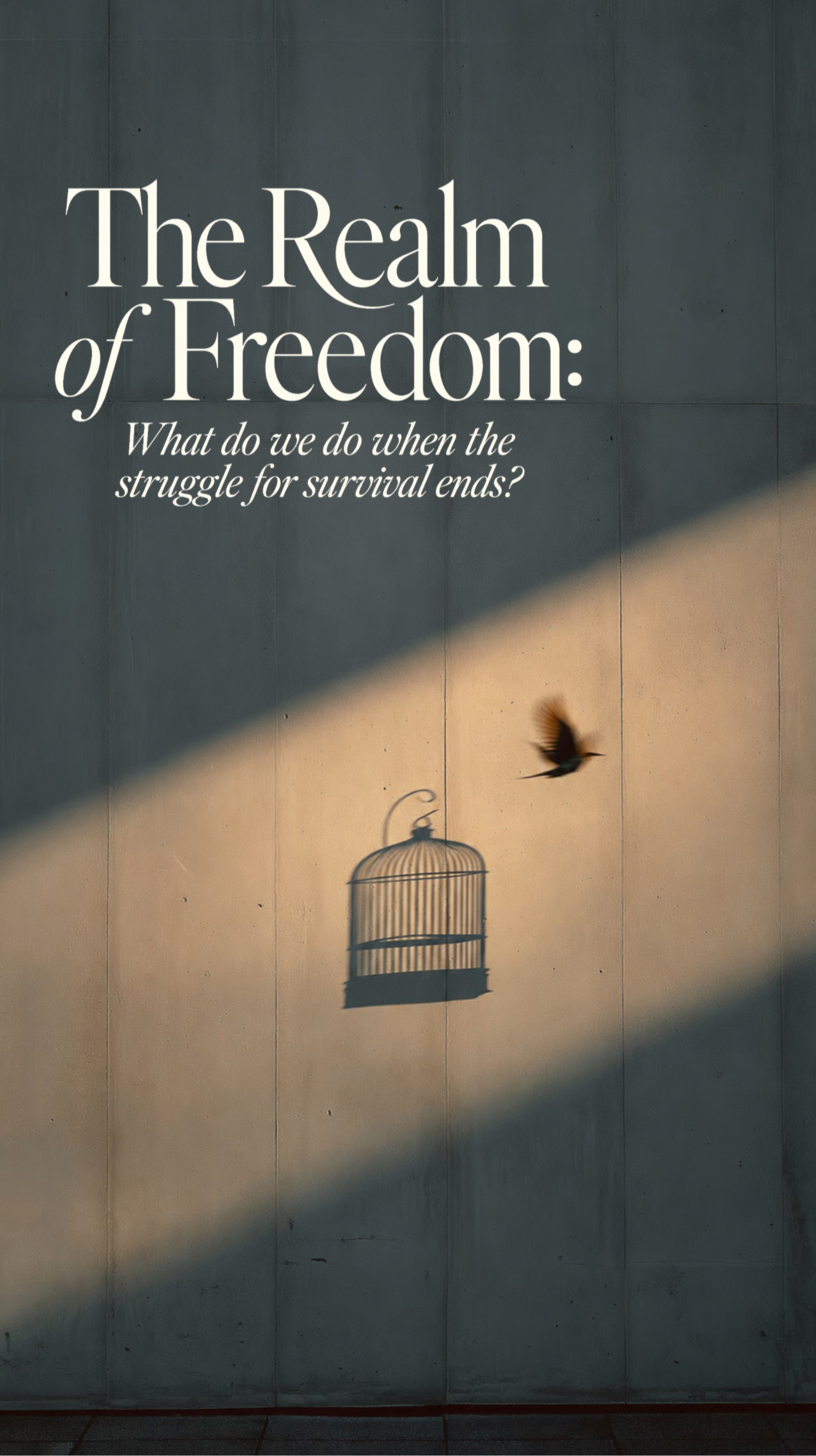
Karl Marx described this ultimate transition in the final released volume of Kapital. He drew a line between the Realm of Necessity (the labor that must be done merely to survive and reproduce) and the Realm of Freedom (the development of human energy which is an end in itself).
“In fact, the realm of freedom actually begins only where labour which is determined by necessity and mundane considerations ceases; thus in the very nature of things it lies beyond the sphere of actual material production. … Beyond it begins that development of human energy which is an end in itself, the true realm of freedom, which, however, can blossom forth only with this realm of necessity as its basis. The shortening of the working-day is its basic prerequisite.”
— Karl Marx, Capital, Volume III (1894)
As long as we live under capitalism, our entire existence is chained to the Realm of Necessity. Communism and the total automation of production are not the end of human history.
They are the end of our pre-history.
When we no longer have to spend 80% of our waking lives justifying our right to exist to an employer, we do not become idle. We become the conscious authors of our own destiny. To believe that humanity would simply stagnate without the threat of poverty is to view a lion born in a cage and conclude that it is in the lion’s nature to sit quietly in a 10-foot box.
We are opening the cage.
Or we will die caged by history.