1847
The Communist League commissions a programme
The commission given to Marx and Engels already joins doctrine to organization: communists require a public programme, not merely a secret society.
Exhibition 01
This exhibition follows one problem through four generations of communist writing: a party is not merely a crowd gathered under a name, but the organized bearer of a programme, a strategy, and a historical task.
1847
Room I
The earliest communist party did not first appear as a mass organization. It appeared as a claim: that a class movement required a programme able to state its historical direction openly. The Manifesto was written for the Communist League, but it immediately exceeded the scale of that organization by defining communists through their relation to the movement as a whole.
That beginning matters. In this tradition, the party is not an afterthought added once a movement becomes large enough. It is the form through which the movement becomes conscious of its aims, its enemies, and the world it intends to make.

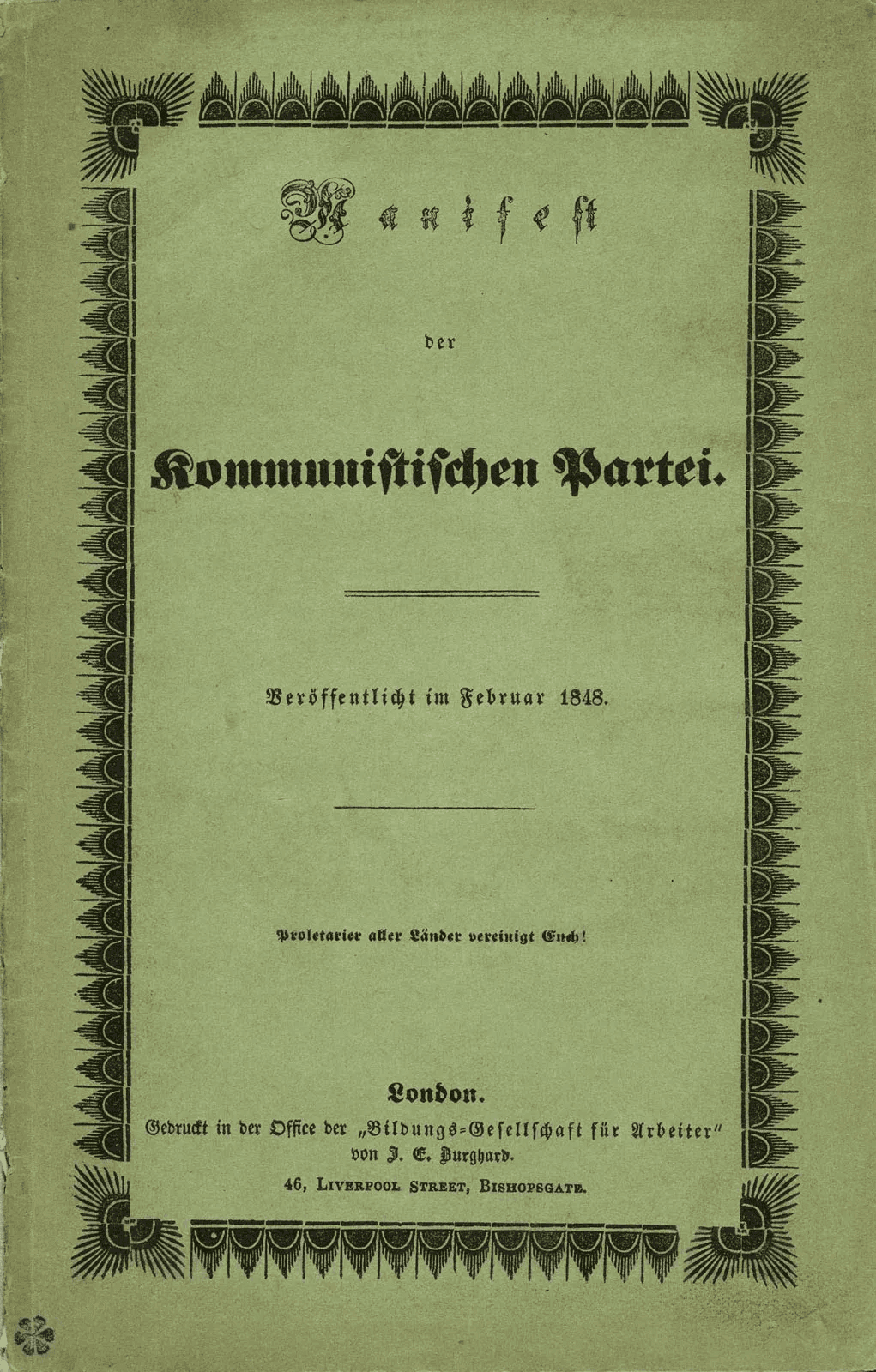
The first publication of the Manifesto made programme visible as a political act.
Wikimedia Commons
The opening sheet of the Manifesto, where a secret league turns outward and addresses Europe.
Wikimedia CommonsRoom II
By 1875, the problem had changed form. The German workers' movement was larger, but Marx treated the proposed Gotha Programme as a retreat. His objection was not to unity as such; it was to unity purchased by blurring the principles on which a workers' party would have to stand.
The critique is severe because programmes do work. They define what a party teaches its members to expect, what compromises it normalizes, and what future it can still recognize when circumstances become difficult.

Marx in the year of the Gotha critique, when a larger party appeared at the cost of a weaker programme.
Wikimedia CommonsRoom III
At the turn of the century Lenin returned the question to organization. What Is To Be Done? was written against a current that narrowed politics to the spontaneous economic struggle. A revolutionary party, in Lenin's account, had to gather, generalize, and direct experience rather than simply mirror what already existed.
The Bolshevik current did not invent the party question from nothing. It sharpened older Marxist disputes under new conditions: underground work, a vast empire, and a movement forced to choose between adaptation and preparation.

Iskra was conceived as connective tissue: a newspaper able to bind scattered circles into a political organization.
Wikimedia Commons
By 1917, the organizational question was no abstraction; it sat inside the problem of taking and holding power.
Wikimedia Commons
The new International tried to scale revolutionary organization beyond one country after the Russian victory.
Wikimedia CommonsRoom IV
The Lyon Theses were written after the first revolutionary wave had already begun to recede. Their central move is to refuse two reductions at once: the party is neither an electoral machine nor a sociological sample of the class. It is the organization that preserves and acts upon the communist programme through changing phases of struggle.
That ending gives the exhibition its title. The party question is not merely about structure charts or membership counts. It is about whether a movement can remain intelligible to itself when success, defeat, growth, and isolation each tempt it toward a different kind of forgetting.

Bordiga's later intervention presses the issue of continuity when expansion has already given way to retreat.
Wikimedia CommonsReading room