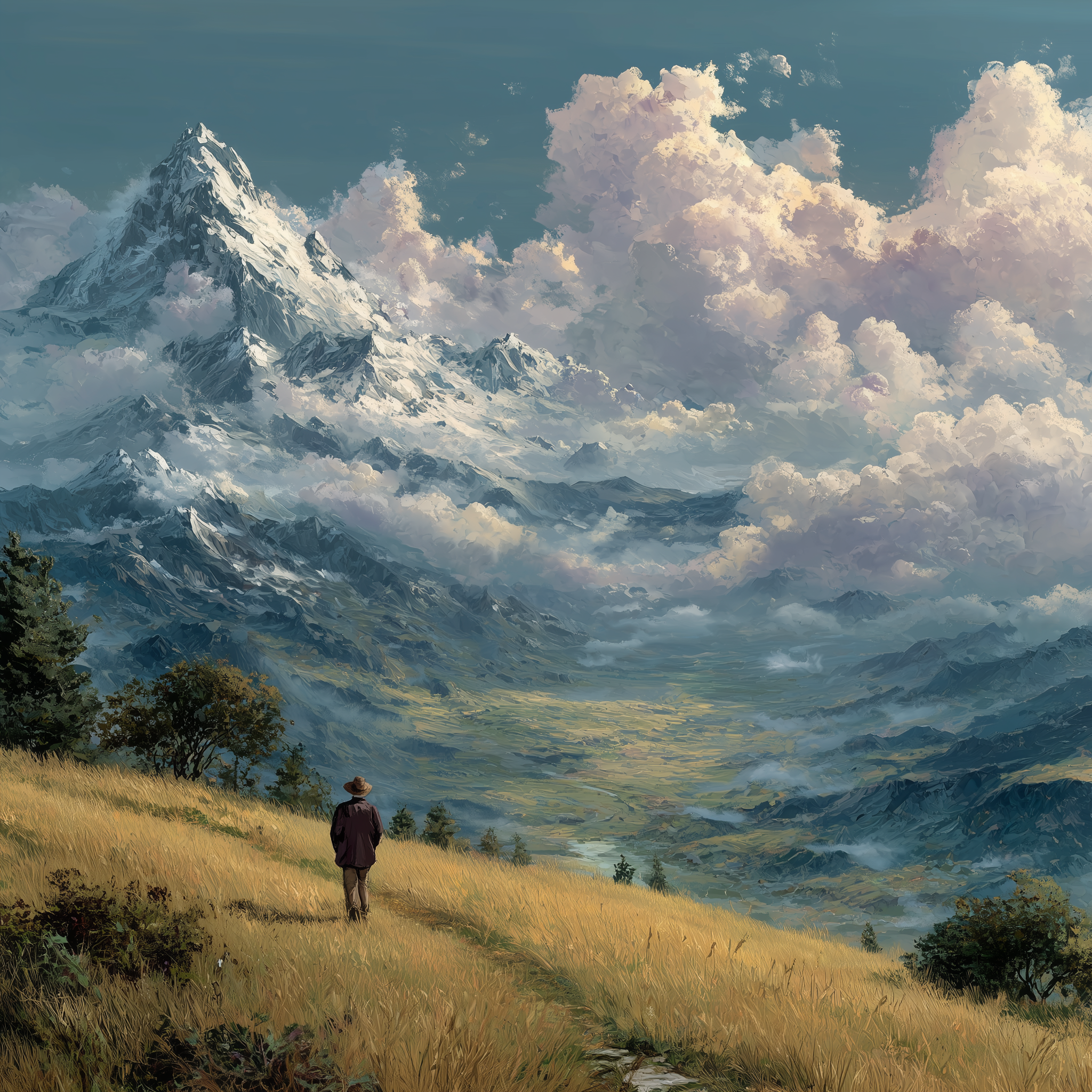
Introduction: The View from the First Summit
In the first part, we stood at the trailhead, haunted by the single, unchangeable line of the past and faced with the daunting infinity of the future. In the second, we took the first difficult steps, learning to walk forward, enduring the friction of a new path and navigating by a compass of intention rather than a pre-drawn map. We learned that the journey is a discipline.
This final part is about the first reward of that discipline. It is not about reaching a final destination, but about pausing on the first major summit you have earned. It is about the act of turning around, not with nostalgia or regret, but with the clear eyes of the person you have fought to become. It is about looking back, this time consciously, to understand the architecture of your own transformation. Part I was about being defined by the past; Part III is about defining yourself by the journey you took to leave it behind.
I. The Landscape of the Past, Re-drawn
"We shall not cease from exploration
And the end of all our exploring
Will be to arrive where we started
And know the place for the first time."
— T.S. Eliot, Little Gidding
From this new height, the map of your past looks entirely different. The single, black line that once seemed to be your entire story is now just a starting point in a vast and complex landscape. The "ghost roads"—the branches not taken that once whispered of regret—are now silent. From here, you can see where they would have led, and you understand, with a quiet and settled certainty, that they were not your paths. They were necessary illusions, the contrasts that gave your own chosen direction its meaning.
You look back at the storms you weathered, the seemingly endless plateaus you crossed. From the ground, they felt like punishments, like meaningless obstacles. From this vantage point, you see them as the crucial, formative features of the terrain. The storm was not an obstacle; It was a test to see how much you really want to push forward. You see the past not as a series of events that happened to you, but as a series of challenges you responded to.
II. A Dialogue with a Former Self
You can now look back at the person who stood at that trailhead and see them clearly for the first time. You see their fear, their uncertainty, their attachment to old habits. But you no longer feel the sting of shame or the burden of their limitations. Instead, you can feel a kind of compassionate understanding.
That person was not a failure. They were the block of uncut marble, filled with potential but also with flaws and insecurities. Every difficult step you took was an act of carving away what was not essential, of freeing the form that was waiting within.
You can now meet that former self not as an enemy to be fled, but as a stranger to be welcomed home. You can acknowledge their struggle and thank them for having the courage to take that first, difficult step.
Love After Love
The time will come
when, with elation
you will greet yourself arriving
at your own door, in your own mirror
and each will smile at the other's welcome,
and say, sit here. Eat.
You will love again the stranger who was your self.
Give wine. Give bread. Give back your heart
to itself, to the stranger who has loved you
all your life, whom you ignored
for another, who knows you by heart.
— Derek Walcott
III. The Architecture of Your Strength
This transformation was not an accident. It was the result of a conscious act. You wanted to be better, stronger, more than you were. Now, looking back, you can see the direct results of that intention. You can trace a line from a specific moment of discipline to a new strength you now possess.
That difficult project you forced yourself to finish built the resilience you can now call upon every day. The uncomfortable conversation you chose to have laid the foundation for the honesty that now defines your relationships. The skill you practiced when you were tired and uninspired is now a source of new found confidence in yourself.
You are the architect of the person you have become. Instead of your character being a gift or an accident of birth, it is now a structure you have built, brick by painful brick, choice by deliberate choice. Looking back is the act of surveying that structure, of understanding its foundations, of seeing that it is solid and that it is yours.
The Next Horizon
But looking back only shows you where you came from, but you now have to walk on. This is the end of your first journey. It is the moment you fully integrate the lessons of your transformation and internalize the proof that you are capable of conscious self-creation.
The future no longer looks like an escape from the past, but like a new territory to be explored with the strength and wisdom you have earned. The rest of your life is not about fixing what was broken, but about building upon the powerful foundation you have now established.
You have proven to yourself that the chisel is in your hand. You have learned how to use it. You have seen the form you can bring forth from the stone. Now, you can turn from the summit you have reached, look out at the next, higher range of mountains on the horizon, and begin to walk again—not as one who is fleeing the past, but as one who is consciously, deliberately, and joyfully building the future.
You did well.
Now walk on.