Introduction: The First day of the Rest of your Life
So, here we are. Or rather you. You have decided then. You have acknowledged the past but refused to be defied by it for eternity. You have felt the weight of the choices in your hand and finally understood that the art of your life is not in what has been made, but in the continuous act of making. This marks the first day of the rest of your life.
But this decision alone is not a discipline. The moment after this is the one that truly matters, for it is filled with an ancient force: the gravity of your old life pulling you back, and the difficult, unpaved ground of the new path ahead. In Part I you let go of your old self, the self that made some right choices, some wrong choices and some in between. The self that stands right here right now. Part II is about the long, difficult, and beautiful act of walking forward, day by day, day after day.
I. The Friction of the First Steps
"The first step towards getting somewhere is to decide that you are not going to stay where you are." — J.P. Morgan
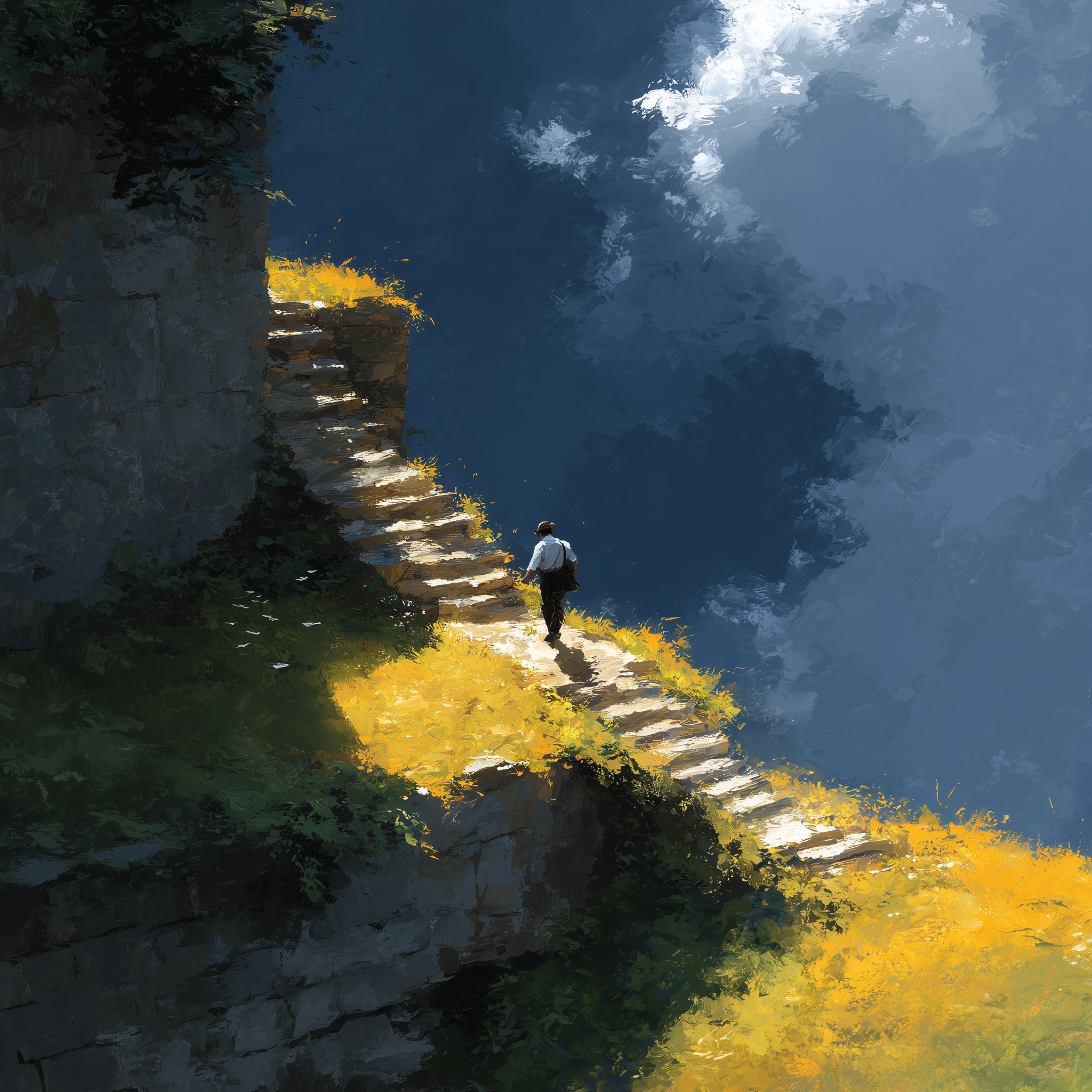
The old path is a well-worn groove. It is paved with habit, familiarity, and the quiet comfort of the predictable. Every step is easy because you have taken it a thousand times before. The new path you have chosen is different. It is overgrown. There are rocks you did not see from the trailhead, and the ground is uneven.
The first steps are the hardest. The very first is almost impossible. This is the point where the initial burst of inspiration meets the reality of effort. It is the moment your old self, the comfortable you, whispers that the work is too hard, that the old life was fine, that it is better to be a finished piece that knows its outcome than an unfinished work that requires effort and sweat.
This marks the first test: the willingness to endure. It is the understanding that the strain you feel is not a sign that you have made the wrong choice, but a confirmation that you are creating something new. Each step is an act of clearing the way, not just for your future self, but for the person you are in active becoming.
II. The Compass, Not the Map
As you move forward, the single trailhead gives way to a thousand new intersections. The future is not one choice, but an endless series of them. Which of these new green branches do you take? How do you know if you are on the "right" one?
But the beauty of this thing called life is: There is no single "correct" path. You are learning to navigate with a compass. A Compass that will lead you to your deepest sense of purpose, to the answer to the question: "What is the work I am here to do?"
At every fork in the road, you do not need to predict the entire journey. You only need to consult the compass and choose the path that aligns with your true north. Some of these paths will be detours. Some will lead to dead ends from which you must backtrack. Don’t see it as failure, you are only navigating. As are we all. A ship's captain does not set a single course and lock the wheel; they make constant, small adjustments in response to the winds and the currents, always keeping their eye on the star that guides them. Trust your compass and not the illusion of a perfect map.
III. The Plateau and the Storm
There will be days when the path seems to stretch on forever, flat and unchanging. The scenery will become monotonous, the initial excitement will fade, and the work will feel like a grind. This is the plateau. It is not a sign that you have stopped moving, but a test of your endurance. It is here, in the quiet repetition of the work, that the real foundations of mastery and character are laid. The greatest progress is often made in these long, unglamorous stretches.
Then there will be days when the storm hits. An obstacle you never anticipated—a failure, a loss, a crisis—will rise up and block the path completely. This is an invitation to grow stronger. It is the resistance that forces you to develop muscles you never knew you had. It is the wind that threatens to extinguish your fire, but which, if you protect it, will only make it burn brighter. Do not curse the storm. Learn to build a better shelter, and to dance in the rain.
IV. The View from the Hill
"We shall not cease from exploration
And the end of all our exploring
Will be to arrive where we started
And know the place for the first time."
— T.S. Eliot, Little Gidding
After you have walked for a while, after you have endured the friction, navigated with your compass, and weathered the plateaus and storms, take a moment to turn around. Look back at where you came from.
From this new vantage point, the map of your past looks different. The single, black line that once seemed so defining is now just one part of a much larger landscape. The "ghost roads"—the paths not taken—no longer look like regrets, but like necessary forks that guided you here. You will see that the obstacles you overcame were not random acts of cruelty, but the very things that gave you the strength to reach your current position.
You will look at the reflection of your old self, not with shame, but with a kind of gentle understanding. You will see it not as a failed version of you, but as the necessary foundation from which the new you was carved. This is the gift of the journey: Not to erase the past, but to transform your relationship to it.
The Unfolding Present
The rest of your life is not a destination to be reached. It is not a summit to be conquered or a statue to be finished. It is the process of the journey itself. The meaning is not found in the final arrival, but in the quality of attention and intention you bring to each step.
Your path is not something you find, but something you create with every choice you make. The future is not a place you are going to, but a place you are bringing into being. The work is never done, and that is the most beautiful part. It means you are always alive with the potential for change, for growth, for the next act of creation.
The compass is true. The path unfolds before you, one step at a time. Keep walking.